Overview
The indicators paint a picture of an economy that has moved past the pure post-COVID rebound and into a more stable expansion. Growth is still strong in the most recent year, which suggests demand and production have stayed resilient even after the reopening surge faded. At the same time, inflation has come down a lot from its earlier spike, which implies that the biggest price shocks from supply disruptions and global commodity pressures have eased, giving households more breathing room and making the economy feel less volatile. Unemployment also looks steady and relatively low compared with the pandemic period, which matters because it supports consumer spending and reduces the risk that growth collapses from weak labor income. The main macro issue the data hint at is vulnerability to external conditions. A country that grows quickly and relies on trade, tourism, and imported inputs can still get hit hard by global slowdowns or sudden increases in food and energy prices. So the trend is positive, but the policy challenge is keeping growth durable while managing exposure to outside shocks and making sure the gains show up in real living standards, not just headline output.
Macroeconomic Indicators
Note: The x axis is time in years, and the Y axis is the value of the GDP in the Dominican Republic in Billions of current US$.
The growth pattern tells a pretty clear story of shock, rebound, and then a return to steadier expansion. Output fell sharply in 2020 because travel and tourism collapsed, services slowed down, and day to day economic activity got disrupted. When restrictions eased, growth jumped in 2021 because people started spending again, businesses reopened, and the economy was basically catching up after a lost year. After that rebound, growth cooled, which is normal once the easy recovery gains are gone. What matters is that growth stayed positive and even strengthened again by 2024, which suggests the economy is not only relying on a one time reopening bounce. The bigger implication is that the country can shift from emergency recovery priorities toward longer run concerns like sustaining investment, improving productivity, and reducing how vulnerable growth is to external shocks like downturns in tourism demand or global financial tightening.
Note: The X axis shows the time in years, and the Y axis shows the inflation rate as a percentage.
Inflation follows a spike and cooldown pattern that fits what happened globally after COVID. Price increases rose quickly in 2021 and 2022 as supply chains were strained, shipping and input costs climbed, and food and energy prices surged. At the same time, demand recovered faster than supply in a lot of sectors, which pushed prices up even more. The recent drop by 2024 is important because it suggests those pressures eased and inflation moved back toward a more manageable range. For households, the spike years likely meant a real squeeze on budgets, especially for essentials, and that can weaken consumer confidence even after inflation slows. For the broader economy, lower inflation reduces the risk that high prices become “normal” through expectations, but it does not remove the underlying vulnerability to commodity shocks. Since the country imports key inputs, another jump in global energy or food prices could still feed into domestic inflation fairly quickly.
Note: X-axis shows years; Y-axis shows unemployment rate (% of labor force).
Unemployment rising around 2020 and then falling afterward matches the basic macro logic of the pandemic cycle. When GDP dropped, firms cut hours, slowed hiring, or let workers go, especially in sectors tied to tourism and in person services. As output recovered, unemployment declined and then stabilized in recent years, which supports consumption because more people have steady income and the economy is not fighting a persistent jobs crisis. The main issue is that a stable unemployment rate does not automatically mean the labor market is “healthy” in a deeper sense. Many countries can have low unemployment while still dealing with underemployment, informal work, or weak wage growth, and those problems matter for living standards and long run productivity. So the trend is reassuring on the surface, but the macro question is whether job creation is translating into better quality work and rising real incomes, not just more employment on paper.
Note X-axis shows years; Y-axis shows the percent of Fiscal Year GDP..
Government debt as a share of GDP in this series looks like it rose a lot around the pandemic and then is expected to slowly ease over time, rather than keep climbing every year. The idea is simple: after a big shock like COVID, governments usually borrow more to cover extra spending and lower tax revenue, so the debt ratio jumps. Later on, if the economy keeps growing and budgets tighten up a bit, the debt ratio can gradually come down even if the country still has debt. The main implication is that debt is not an emergency on its own, but it can limit options. When the debt ratio is higher, the government has to spend more of its budget on interest, especially when global interest rates are high, and that can leave less money for things like infrastructure, education, and social programs. The “macro issue” the data point to is vulnerability. If growth stays strong, managing the debt burden gets easier. If growth slows or borrowing costs rise again, debt can feel heavier quickly and force tougher tradeoffs in fiscal policy.
AD–AS Analysis
Quédate en Casa
Quédate en Casa was an emergency fiscal transfer program introduced in 2020 during the COVID-19 crisis in the Dominican Republic. It provided income support to poor and vulnerable households at a time when the economy was being hit by falling tourism, employment disruption, and weaker household earnings. The purpose of the policy was to protect basic consumption and reduce the severity of the downturn. This policy primarily affected aggregate demand, because the increase in government spending on household support raised G and helped shift AD to the right.
AD–AS
(1): An increase in G shifts AD(G1) outward to AD(G2).
IS–LM
(1): An increase in G shifts IS(G1) outward to IS(G2).
(2): PSR > P1, so LM(P1) shifts in to LM(PSR).
(3): PLR > PSR > P1, so LM(PSR) shifts in to LM (PLR).
Labor Market
(1): PSR > P1, so z (Pᵉ/P1) shifts down to z (Pᵉ/PSR).
(2): Labor supply returns to its original point since z (Pᵉ/PLR) = z (Pᵉ/P1).


Electricity Reform for Sustainable Growth Development Policy Loan (DPL)


The Electricity Reform for Sustainable Growth Development Policy Loan (DPL) was approved in 2022 to support a broad reform of the Dominican Republic’s electricity sector. The policy focused on improving governance, reducing inefficiencies, addressing distribution losses, and improving the reliability and financial sustainability of electricity service. It was implemented because the electricity sector had long been a structural weakness that raised business costs and reduced productivity across the economy. This policy primarily affected aggregate supply, because more reliable and efficient electricity lowers production costs and improves productive capacity, shifting AS to the right.
AD–AS
(1): An increase in A simultaneously shifts LRAS(A1) outward to LRAS(A2) and SRAS(A1) outward to SRAS(A2).
IS–LM
(1): PSR < P1, so LM(P1) shifts outward to LM(PSR).
(2): PLR < PSR < P1, so LM(PSR) shifts outward to LM (PLR).
Labor Market
(1): PSR < P1, so z (Pᵉ/P1) shifts upward to z (Pᵉ/PSR), also a increase in A shifts Ld(A1) outward to Ld(A2).
(2): Labor supply returns to its original point since z (Pᵉ/PLR) = z (Pᵉ/P1).
Comparison with Real Economic Outcomes
The real-world outcomes were only partly consistent with the AD–AS predictions. After Quédate en Casa, the Dominican Republic still had a major recession in 2020, with GDP falling and unemployment rising, which shows the program could not fully cancel out the pandemic shock. Still, the economy rebounded strongly in 2021, and inflation also increased, which fits the AD–AS idea that stronger demand raises output and can push prices up. After the Electricity Reform for Sustainable Growth Development Policy Loan, inflation came down over the next two years, which is consistent with a rightward shift in aggregate supply, but growth did not immediately rise in a smooth way. Instead, growth slowed in 2023 before recovering later. The data suggest that Quédate en Casa worked mostly like an AD-support policy, while the electricity reform worked more slowly and looked more like a longer-run AS policy than an immediate short-run one.
Discrepancies and Interpretation
The economy did not match the model perfectly because other things were happening at the same time. In the case of Quédate en Casa, the policy was introduced during COVID, when tourism collapsed, jobs were lost, and business activity was disrupted, so even though transfers supported spending, the larger shock still pushed output down. In the case of the Electricity Reform DPL, the effects were gradual because structural reforms usually take time to improve efficiency, and some of the benefits were likely offset by other factors like weaker global demand and tighter monetary policy. This shows one weakness of the basic AD–AS model: it is useful for showing the direction of change, but it does not capture timing, expectations, implementation problems, or overlapping shocks very well. A more complete explanation would combine AD–AS with those extra factors to better match what actually happened in the Dominican Republic.
Extreme Macroeconomic Event
When it occurred
The crisis came to a head in April 2003, when the Dominican government took over Banco Intercontinental (Baninter), the country’s second-largest commercial bank, after uncovering a massive fraud. The bank’s president and chief shareholder, Ramón Báez Figueroa, was arrested shortly after, along with two other top executives.
What happened:
Baninter had been secretly running a “bank within a bank” since as early as 1989. Using special software that kept fraudulent activity off the official books, bank executives used depositor funds to buy companies linked to bank insiders, forgave millions in bad loans to connected parties, and siphoned money for personal use. When a proposed merger began bringing outside scrutiny, Baninter officials ordered workers to erase records of the hidden loans.
By the time authorities were involved, a total of $2.2 billion USD was owed to depositors (roughly two-thirds of the entire national budget at the time). It’s worth noting that Báez was well known as one of the Dominican Republic’s richest and most influential figures. According to the central bank’s investigation, Baninter’s generosity extended deep into the country’s political establishment through gifts of received bulletproof vehicles and Rolex watches.
The bank also provided monthly stipends to 70 army generals. The government guaranteed all depositors would be repaid, which required the Central Bank to inject massive liquidity into the system. Additionally, two other mid-sized banks had their own management problems and required government assistance and restructuring around this time period.
Conditions leading up to it:
For much of the period leading up to the crisis, the Dominican Republic had growth driven by tourism, remittances, and export industries. This prosperity, however, masked serious weaknesses in banking oversight. Governance problems (accounting fraud and mismanagement) went undetected at Baninter for many years, even after a formal Financial Sector Assessment had been completed. Banking regulators and the bank’s outside auditor, PricewaterhouseCoopers, were deceived by the bank’s software program, which kept fraudulent activity off the official books. Starting in 2001, the country also began facing external pressures: rising oil prices and the economic slowdown following September 11 weakened demand from the United States and Europe, adding strain to the economy of the Dominican Republic.
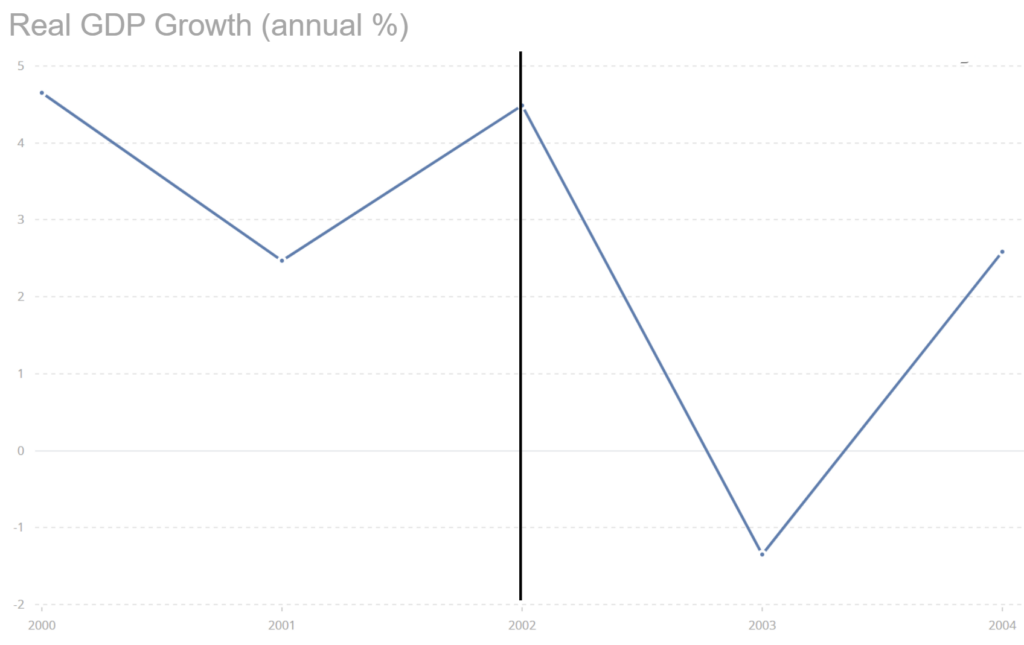
Note: The X-axis shows time in years, and the Y-axis show real GDP Growth (annual %).
Before the crisis, the Dominican Republic had been growing at around 4% in 2002 and had strong growth throughout from the 1970s to the 1990s. In 2003, the crisis caused growth to be in the negatives, -1.3% RGDP growth. (Source: World Bank Group, 2026)
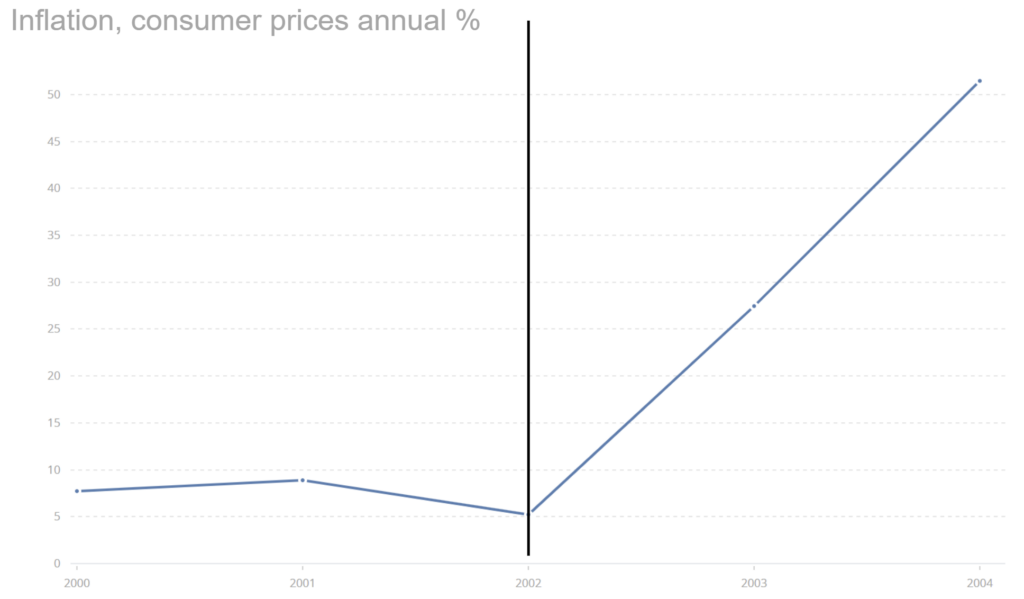
Note: The X-axis shows time in years, and the Y-axis shows the inflation as a percentage.
Before the crisis, inflation in the Dominican Republic was at 5.2%. Though, in 2003 the inflation jumped up to 27.4% and even went as high as 51.5% in 2004. (Source: World Bank Group, 2026)
Policy Response and Aftermath Immediate Response:
The central bank’s priority was preventing a complete collapse of public confidence in the financial system. The government guaranteed that all depositors at Baninter would be repaid in full. To fund this, the Central Bank injected massive liquidity into the system and issued large amounts of certificates to cover the losses. The same approach was extended to two other mid-sized banks that were caught up in the contagion and required restructuring.
- Fiscal Measures: To contain the damage to public finances, the government introduced a series of emergency measures including expenditure cuts, a tax on checks, an import surcharge, and an increase in the tourist departure tax. The public sector deficit was projected to be held at around 3.5% of GDP for 2003. However, the IMF stressed that these were temporary fixes and pushed for more comprehensive tax and spending reforms to generate sustainable surpluses over the medium term.
- Monetary Policy: The Central Bank tightened monetary policy to slow inflation and stabilize the peso, raising interest rates and shifting toward the offering of bonds.
- IMF Program: The government entered into discussions with the IMF for a loan of around $1 billion to help stabilize the economy. In exchange, the Dominican Republic committed to fiscal consolidation, wage freezes in the public sector, and broader structural reform. Banking Reform: Authorities launched a comprehensive program to clean up the financial sector, including audits of all banks, stronger prudential regulations, and improved bank supervision. Forensic audits were initiated to establish the legal responsibility of Baninter’s former owners and managers, and the government pursued legal channels to recover assets from those found responsible for the fraud.
- Aftermath: Despite the severity of the crisis, the Dominican Republic’s recovery was relatively swift once stabilization policies took hold. The IMF and the incoming Fernández administration worked together to implement fiscal discipline and banking reforms. The country returned to strong growth within a couple of years, though the crisis left lasting damage in the form of higher public debt and weaker institutions.
(Sources: IMF Article IV Consultation, 2003; NYT, 2003; The Economist, 2003)
Economic Growth in the Dominican Republic
The Dominican Republic has experienced one of the strongest long-run growth stories in Latin America and the Caribbean. Since the 1960s, the country has moved from a mostly agricultural economy toward a more diversified economy based on services, tourism, construction, manufacturing, free-trade-zone exports, and remittances.
Real GDP per capita has risen sharply over time, reaching about $9,168 in constant 2015 U.S. dollars in 2024, its highest recorded level in the World Bank series. A clear long-run pattern is that growth was uneven in the early decades after the Trujillo dictatorship, but became much stronger after the 1990s and especially after the early 2000s. The Dominican Republic grew rapidly from 2005 to 2019, averaging about 5.8% annual GDP growth, making it one of the fastest-growing economies in Latin America and the Caribbean.
This growth helped reduce poverty and expand the middle class, with the World Bank noting that nearly 3 million people were lifted out of poverty over the past two decades. The country has also faced periods of decline or disruption. The COVID-19 pandemic in 2020 hurt tourism, employment, and overall economic activity, since tourism is one of the Dominican Republic’s most important industries. However, the recovery was relatively strong because tourism returned, remittances stayed important, and the government used policy support to stabilize the economy. The IMF projected growth around the country’s long-term trend of about 5% in 2024 and after, supported by tourism, construction, free-trade zones, and remittances.
Drivers of Growth
One major driver of growth has been capital accumulation and foreign investment. Foreign direct investment has supported tourism, construction, mining, manufacturing, and services. World Bank analysis notes that FDI averaged about 4% of GDP from 2005 to 2019, helping finance sectors that became central to the country’s growth model. Hotels, airports, roads, ports, and urban construction all helped increase productive capacity and connect the country more closely to global markets. A second driver has been structural transformation.
Earlier in its history, the Dominican Republic relied more heavily on agriculture, including sugar and other primary goods. Over time, agriculture became a much smaller share of GDP, while services became dominant. In 2024, agriculture accounted for only about 4.5% of GDP, showing how far the economy has shifted away from farming and toward services, tourism, finance, transportation, and trade. This shift matters because services and export-oriented industries have allowed the country to earn more foreign exchange and create new forms of employment. A third driver is labor force growth and human capital.
The Dominican Republic’s growing population and expanding workforce helped increase total output, but growth has not always been equally inclusive. A World Bank/UNDP jobs diagnostic argues that even though the country’s GDP per capita grew much faster than the regional average, poverty reduction and job quality did not improve as much as expected. This suggests that the country’s challenge is not only growing fast, but also making growth produce better wages, more formal jobs, and broader opportunities.
Productivity and policy changes also played a role. More stable macroeconomic policy, stronger monetary management, trade openness, tourism promotion, and free-trade-zone policies helped create a better environment for investment. The IMF has emphasized that prudent policy helped the country recover from shocks and keep inflation closer to target after the pandemic period.
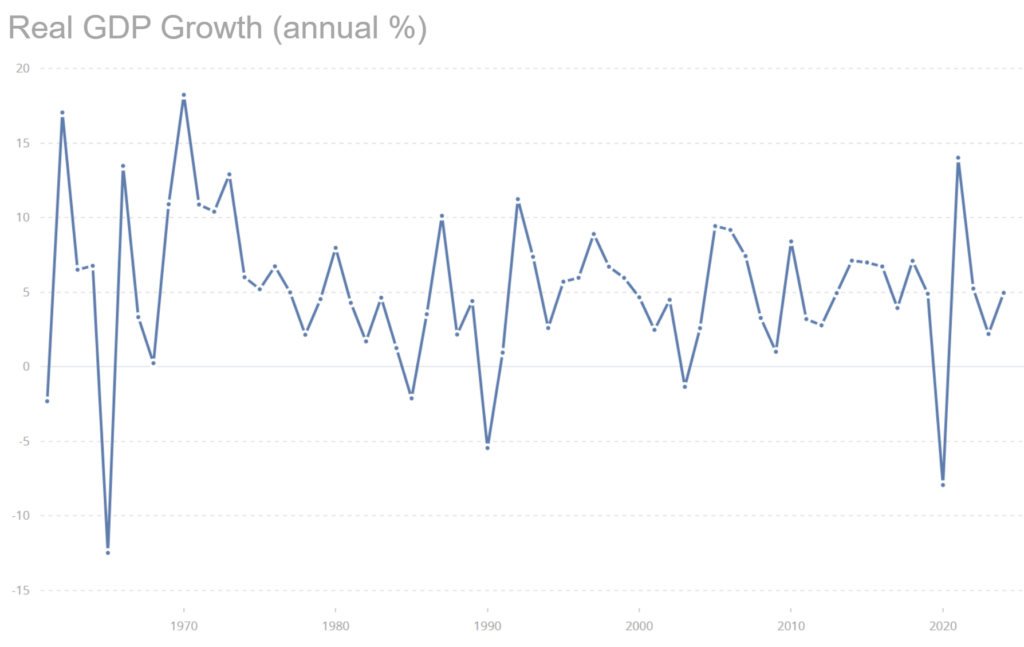
Note: The X-axis shows time in years, and the Y-axis shows real GDP Growth (annual %)
This shows the ups and downs: fast growth periods, the 2003–2004 banking crisis effects, the 2008–2009 global crisis slowdown, the 2020 COVID-19 drop, and the rebound after 2021 (Source: World Bank Group, 2026)
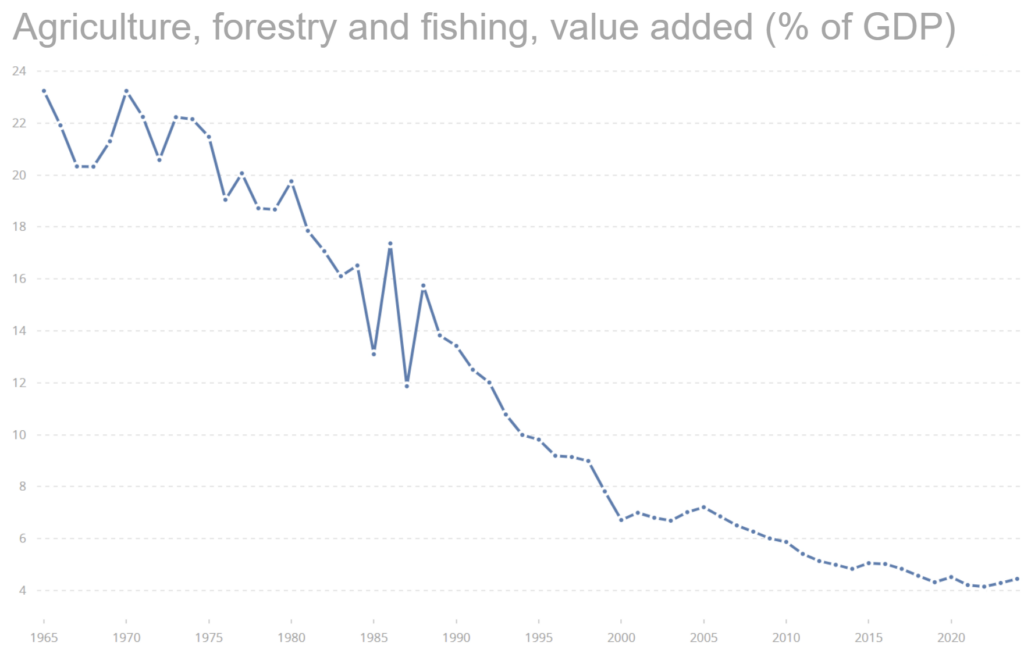
Note: The X-axis shows time in years, and the Y-axis shows Agriculture, forestry, and fishing, value added as a percentage of GDP.
This shows the country’s structural transformation from agriculture toward services and industry over the past century (Source: World Bank Group, 2026)
References
- International Monetary Fund. (2020, April 29). IMF Executive Board approves US$650 million in emergency assistance to the Dominican Republic to address the COVID-19 pandemic. IMF. Retrieved from https://www.imf.org/en/news/articles/2020/04/30/pr-20195-dominican-republic-imf-executive-board-approves-us-650-million-in-emergency-assistance
- International Monetary Fund. (2022). Dominican Republic: 2022 Article IV consultation—press release; and staff report(Country Report No. 22/217). Retrieved from https://doi.org/10.5089/9798400214196.002
- International Monetary Fund. (2026, January, 22). General Government Gross Debt for Dominican Republic. FRED. Retrieved from https://fred.stlouisfed.org/series/DOMGGXWDGGDP
- World Bank. (2022, March 4). Dominican Republic: Electricity reform for sustainable growth development policy financing (Report No. PGD279). Retrieved from http://documents.worldbank.org/curated/en/202841649092948080
- World Bank. (2024). GDP (current US$): Dominican Republic. World Bank Data. Retrieved from https://data.worldbank.org/indicator/NY.GDP.MKTP.CD?contextual=default&locations=DO
- World Bank. (2024). Inflation, consumer prices (annual %): Dominican Republic. World Bank Data. Retrieved from https://data.worldbank.org/indicator/FP.CPI.TOTL.ZG?locations=DO
- World Bank. (2024). Unemployment, total (% of total labor force)(national estimate): Dominican Republic. World Bank Data. Retrieved from https://data.worldbank.org/indicator/SL.UEM.TOTL.NE.ZS?locations=DO&name_desc=false
- World Bank. (2025, June 27). Dominican Republic: Electricity reform for sustainable growth development policy loan 1 and 2 (Implementation Completion and Results Report No. ICR00334). World Bank Group.
World Bank. (2025, October). Dominican Republic: Macro poverty outlook. Retrieved from https://www.worldbank.org/en/publication/macro-poverty-outlook